
Book Review: Undrowned
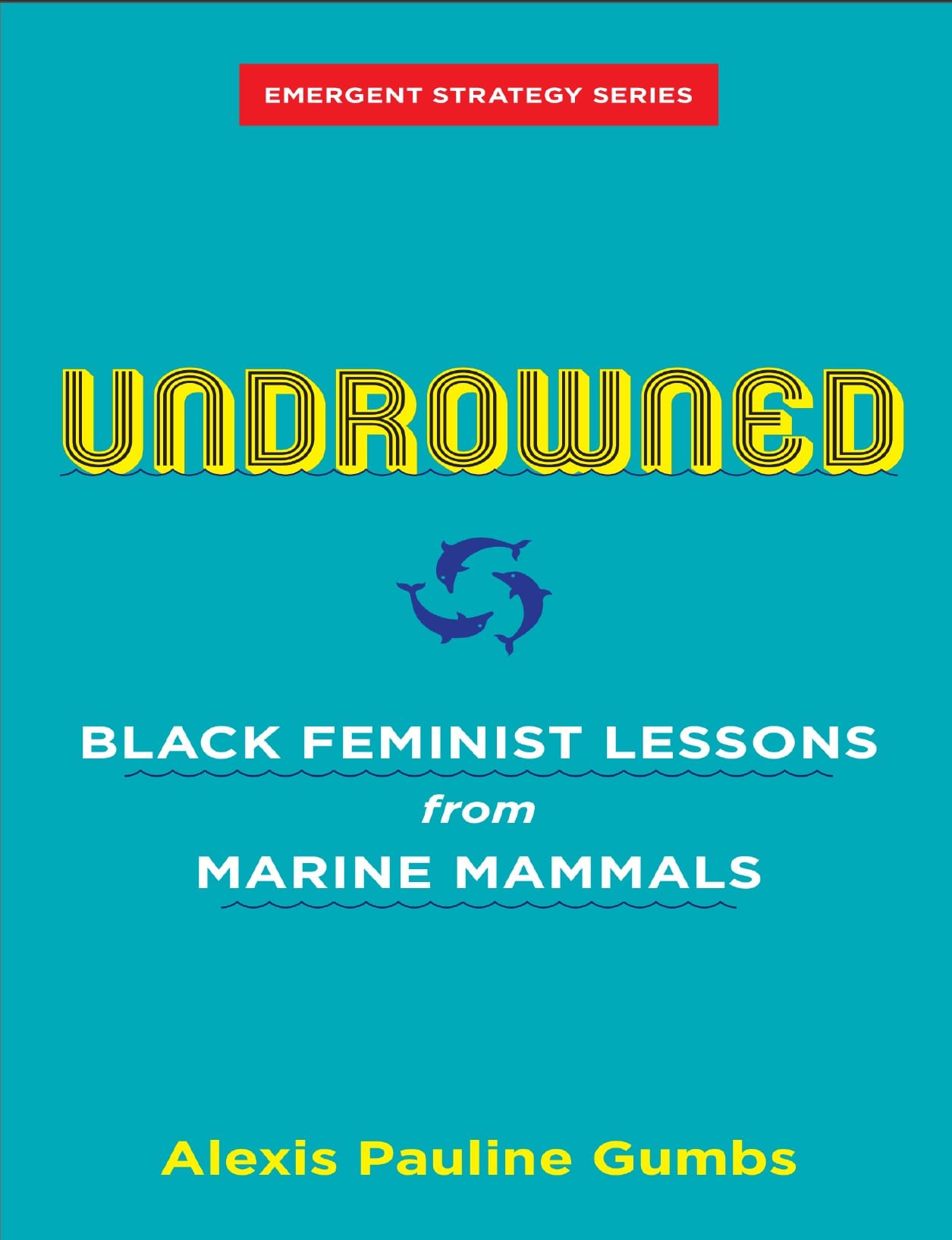
In the summer term 2026, I attended a seminar called "Interspecies Relations: Queer and Decolonial Ecofeminisms in Transnational Anglo-American Contexts," taught by Dr. Sofia Varino. Sofia's teaching method combines (among others) creative writing, concepts of embodiment, empathy and compassion, fluidity, and lived experience with critical queer theory from various disciplines. Unsurprisingly, "Interspecies Relations" turned out to be one of my favorite courses. At the end of the semester, we were asked to hand in a book review of one of the books we discussed in class. I chose Undrowned: Black Feminist Lessons from Marine Mammals (2020, AK Press) by Alexis Pauline Gumbs.
In her book Undrowned: Black Feminist Lessons from Marine Mammals, Alexis Pauline Gumbs discusses the historical events of the Middle Passage, of enslaved Black people drowning (and surviving), of sea mammals becoming extinct/endangered (and surviving), and how all of these conditions connect to the act of breathing. For her poetic analysis, she employs the figure of the "Undrowned" (4), the enslaved who did not drown on these ships sailing to the Americas despite devastating, life threatening circumstances:
I am saying that those who survived in the underbellies of boats, under each other under unbreathable circumstances are the undrowned, and their breathing is not separate from the drowning of their kin and fellow captives, their breathing is not separate from the breathing of the ocean, their breathing is not separate from the sharp exhale of hunted whales, their kindred also. Their breathing did not make them individual survivors. It made a context. The context of undrowning (4).
Throughout the book, which Gumbs refers to as a "guidebook" (9), the author examines the historical events of the Transatlantic Slave Trade and the aftermath through a "queer Black feminist" (12) lens. She identifies acts such as "breathing, remembering, and collaborating" (11) as Black feminist practices and discusses them alongside critical theory to show the ongoing racism, misogynoir, and ableism Black people are still subject to today (4). Speaking from an anti-capitalist (81), queer, disabled perspective (11), Gumbs raises awareness of environmental destruction, ecological hardships, and struggling marine mammals (115, 127) linking them to colonialism (29, 91, 128).
The practices of breathing and undrowning run like a golden thread through the book. They guide the reader through the sections, shaping awareness of how the Transatlantic Slave Trade and—what Saidiya Hartman calls—"the afterlife of slavery"1 correlate, fueled by capitalism (4).
Learning "from and despite the guidebooks" (8) and by filling in the (narrative) gaps with speculation, Gumbs imagines numerous (especially endangered and extinct) marine mammals as "kindred" and "mentors," experts on undrowning (5). This metaphor is used throughout the book, highlighting concepts of marginalized existence, for instance fugitivity, resistance, refusal, and resilience (88, 40, 87, 46).
Gumbs starts the book with a preface which carries the subtitle "a guide to undrowning" (4). In this preface, she theorizes a concept she calls the "scale of breathing" (4), which—according to Gumbs—involves not only flora and fauna but also bodies of water and even the Earth as a whole (4). A concept echoing the "more-than-human" and the "other-than-human."2 Gumbs states that the scale of breathing relates to the "impact of drowning" (4)—a reference to the Middle Passage. She argues that marine mammals have been breathing and drowning (that is, dying) under the same conditions as any other living organism, and that these struggles are not over yet (4). In Undrowned, Gumbs set out to reimagine the act of breathing to overcome the afterlife of slavery by calling on the practices of survival that marine mammals have been using throughout their history (4-5).
A foreword by Black queer activist and editor of Undrowned, adrienne maree brown, follows emphasizing Gumbs centering (Black) liberation in her book (6).
In the introduction, Gumbs tells the reader about her visit at the aquarium to see marine mammals, reading the two guidebooks she bought there—an event that marks the beginning of her research on dolphins, whales, and seals (to name a few) and the subsequent formation of her book (8). She talks about identifying as a mammal, about posting her sea mammal findings on social media, receiving gifts from followers, and being approached by adrienne maree brown offering to publish her texts in the form of a book (8-9). Gumbs also discusses the challenges she was facing while writing, her need "to do some work to disrupt the violent colonizing languages of almost all the texts" (10). Gumbs draws parallels between marine mammals and liberation/social justice movements which inform the meditations in each section to encourage the reader to reflect and "wonde[r] together" (11). She then introduces herself as a queer Black feminist writer and movement worker (12). In her writing, she combines poetry and critical theory; in her movement work, she uses "poetry, ceremony, and facilitation" (12) to build institutions that oppose the dominant discourse and bolster Black feminism (12-13). Gumbs sees her work as part of an "ecology of kindred works" (13), crediting Black feminists close to her such as her her grandmother alongside several collaborators, and artists, including their bodies of work centering marine mammals (13-14). She concludes the introduction by addressing the target audience for her book, stating that Undrowned is for "you and me, the ones who thought our practice of looking at pictures of marine mammals was completely separate from our economic justice work. This is for all of us" (15).
Undrowned consists of twenty chapters which Alexis Pauline Gumbs calls "thematic movements" (11). The first nineteen movements comprise practices such as "breathe", "be vulnerable", and "go deep" (23, 53, 102) which are interlaced with introductions to various marine mammals, among them the bowhead whale, the pantropical spotted dolphin, the leopard seal, and the narwhal. In addition to the descriptions of (some of) the mammals' characteristics, the author weaves in historical data, her own reflections and sentiments, as well as a critical assessment of the systemic violence committed against marginalized lives (particularly against Black people, marine mammals, and their habitat) by colonizers, the patriarchy, and capitalist structures to this day.
Each movement starts with an introductory paragraph that speaks to the section's title, giving an overview of the movement's context. The introductory paragraph also lists the marine mammals featured, and closes with a meditation. What follows are sections that vary in length, depending on how many mammals emerge (mostly three to five). The sections are divided by a circular icon of three bottlenose dolphins, designed by the author's grandmother Lydia Gumbs in 1967 (13). The icon symbolizes the "revolutionary flag, seal, and insignia of Anguilla" (36). Most of these sections focus on one marine mammal at a time, starting with specific (behavioral) patterns characteristic for them, narrated in the form of anecdotes that combines facts and speculation. Gumbs then puts the anecdotes into a personal-political context and concludes the respective sections with a meditation.
Movement twenty stands out from the previous nineteen: it bears the title "Activities" (131) and contains two lists of exercises and meditations based on the 19 other movements. These can be practiced individually or collaboratively. One example of an individual practice includes:
Slow Down: Cancel one thing this week. Just one thing. During that time, look at the live-feed of orcas and just see if an orca emerges at any moment. Or go to sleep and let the orca watch you. (134)
In the "Pod/Squad Version" (135) that follows—to be practiced collaboratively—this particular example turns into:
Slow Down: Choose a passage from this book and read it together one word at a time, taking turns. Go around the circle with each person reading one word until you have read all of the words. What do you notice? (138)
The other eighteen activities are structured in a similar way.
The act of remembering, the collective trauma of the Middle Passage, and the continuous struggle for survival of the more-than-human and the other-than-human constitute recurring themes in Undrowned. Throughout the book, the author references and cites several Black creators and kindred who have been inspiring her work. By naming them, she remembers them, and by remembering them she employs one of the "core Black feminist practices" (11). But she also employs a contrasting concept: she does not want to remember the white guidebook authors, hence she does not name them. Gumbs argues that the "Audubon and Smithsonian guidebooks are the sources of all unattributed quotations in this book" (10) and that she is "doing that on purpose" (10). By not giving credit to the white cis male scientists who wrote/contributed to these books, Gumbs follows a Black feminist/queer of color practice that refuses to further perpetuate the memory of the white patriarchy. To quote Sara Ahmed, "We cannot conflate the history of ideas with white men, though if doing one leads to the other then we are being taught where ideas are assumed to originate. Seminal: how ideas are assumed to originate from male bodies" (27).
Drawing on "Black feminist thought"3 (from scholars, artists, and activists such as Saidiya Hartman, Audre Lorde, Octavia E. Butler, Hortense Spillers, and Ida B. Wells, Gumbs delivers a "poetic intervention" (10) using methods such as meditations, poetry, intimate language, and speculation to create a versatile narrative that negates academic conventions while still holding space for critical theory. However, Gumbs at times reproduces what she critiques: for example, she ascribes pronouns, thoughts, and feelings to several marine mammals—a practice that creates intimacy and empathy in the reader while simultaneously serving as an alternative concept to more matter-of-factly written scientific guidebooks (8). But the pronouns ascribed—she/her and (rarely) he/him—reflect and reproduce precisely the gender binary that Gumbs critiques on the very first page of her introduction (8).
Also during the introduction, Gumbs states that her goal is not to "garner sympathy for marine mammals because they are so much like us. . . . Instead, the intimacy, the intentional ambiguity about who is who, speaking to whom and when is about undoing a definition of the human" (11). Yet, Gumbs's compassionate language and her practice of anthropomorphization—especially when describing certain mammals becoming sick, injured, or disabled—evokes emotion and sympathy in the reader, precisely because the sea mammals are likened to the human.
Undrowned: Black Feminist Lessons from Marine Mammals by Alexis Pauline Gumbs is a poetic-academic approach to the history and aftermath of the Middle Passage, toward a different future "where everyone is free" (14). To show the scale at which destruction, discrimination, and marginalization have been happening, Gumbs employs concepts from a variety of disciplines such as Black studies, disability studies, critical animal studies, environmental studies, and gender/queer studies to draw analogies to marine mammals whose lives have been greatly affected by the same systems that led to colonialism, the enslavement of Black people, and the harmful capitalist practices caused by industrialization and modernity. However, Gumbs does not only draw inspiration from academic disciplines but from speculative fiction (Octavia E. Butler's Wild Seed) and her movement work, too (12-14). In her book, Gumbs creates speculative anecdotes on various marine mammals undergirded by non-fictional elements and critical theory. This eclectic writing practice is also reflected in her language: the non-fictional paragraphs are written in a more factual style while her speculative narrations use a more poetic and compassionate language (10). Her meditations serve as a tool for the reader to engage more closely with the readings, to internalize them by practicing awareness and action—individually or collaboratively. These combined meditation-activities may be Gumbs's way of reimaging the act of breathing.
Undrowned is a copious contribution to Black feminist thought and practice that opens up new ways of critical thinking on what it means to be Black and queer, on solidarity and community, on breathing and (un)drowning, and, of course, on how it all connects to marine mammals and life itself.
Notes
1 See Hartman, Saidiya. Lose Your Mother: A Journey Along the Atlantic Slave Route. Farrar, Straus and Giroux, 2007.
2 Discussed by Joseph Pugliese in his book Biopolitics of the More-Than-Human: Forensic Ecologies of Violence, coincidentally published the same year as Undrowned, in 2020. Rejecting Eurocentrism and practices of othering, Pugliese employs the terms "more-than-human" and "other-than-human" (denoting animals and organic/mineral matter in general) as alternative concepts that stand in direct opposition to the post-human and the nonhuman with the purpose to highlight the entanglement of the human and the more-than-human/other-than-human (3).
3 See Hill Collins, Patricia. Black Feminist Thought: Knowledge, Consciousness, and the Politics of Empowerment. Rev. 10th anniversary ed., Routledge, 2000.
Works Cited
Ahmed, Sara. Living a Feminist Life. Duke University Press, 2017.
Hartman, Saidiya. Lose Your Mother: A Journey Along the Atlantic Slave Route. Farrar, Straus and Giroux, 2007.
Hill Collins, Patricia.Black Feminist Thought: Knowledge, Consciousness, and the Politics ofEmpowerment.Rev. 10th anniversary ed.,Routledge, 2000.
Pugliese, Joseph. Biopolitics of the More-Than-Human: Forensic Ecologies of Violence. DukeUniversity Press, 2020.